
 Bahasa Indonesia
  English
  Türkçe
  Deutsch
  العربية
  中文
中文  Русский
  Español
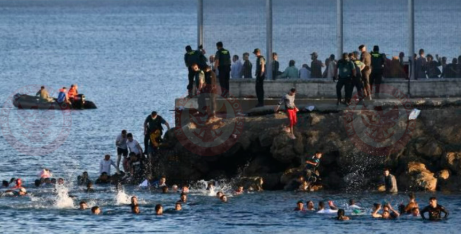
The Spanish government moved quickly following a surge in migration toward Ceuta. After approximately 60,000 migrants reportedly entered the territory from Morocco in recent days, security forces were reinforced to maintain stability in the border area.
Geographically, Ceuta is located on the African mainland and surrounded by Moroccan territory. Administratively, however, it is part of Spain and, by extension, the European Union. This status gives Ceuta a strategic yet sensitive position regarding international migration issues.
On August 2, 2026, groups of migrants were seen walking toward the border post to return to Morocco under the escort of Spanish military personnel. This process was carried out in stages as part of efforts to alleviate overcrowding in Ceuta.
Morocco is not currently experiencing a war like Sudan, Syria, or Ukraine; the country is relatively stable in terms of politics and security. However, several factors drive many Moroccans—especially young people—to seek entry into Spain via Ceuta:
1. Difficulty finding employment.
This is the primary reason. Unemployment rates among Moroccan youth are quite high. Many school and university graduates struggle to secure jobs that offer a decent wage.
2. Ceuta is a "piece of Europe" in Africa.
Once a person successfully enters Ceuta, they are legally within Spanish and European Union territory. Although they may not be able to proceed immediately to the Spanish mainland, the chances of applying for asylum or finding a way into Europe are perceived as greater than if they remained in Morocco.
3. The influence of social media and rumors.
During this crisis, both the Moroccan and Spanish governments have stated that social media exacerbated the situation. Rumors circulated claiming that: border security was lax, anyone who managed to enter would not be immediately repatriated, and there was even a misinterpretation of a Spanish court ruling, which was perceived as offering an opportunity to reside in the country. These rumors spread rapidly and were exploited by human smuggling networks to encourage thousands of people to attempt the crossing.
4. Not just Moroccan nationals
Although many originate from Morocco, not all are Moroccan citizens. There are also migrants from: Sudan, Senegal, Mali, Guinea, Côte d'Ivoire, and other sub-Saharan African countries. Some have lived in Morocco for years before attempting to enter Europe. Some are fleeing conflict, while others are seeking employment.
This phenomenon once again demonstrates that the issue of migration is not merely about the movement of people; it is also shaped by economic disparities, regional conflicts, and diplomatic relations between nations. Until these root causes are addressed, Ceuta is expected to remain one of the most vulnerable points in the migration crisis facing Europe.



Comments (0) View in forum
Discuss this article in the community Ask questions, share your thoughts, and chat with other members.20 people have already joined this community. Join in to comment and like posts!
No messages yet — be the first.