 Bahasa Indonesia
  English
  Türkçe
  Deutsch
  العربية
  中文
中文  Русский
  Español
A diaspora perspective on Indonesia's development priorities
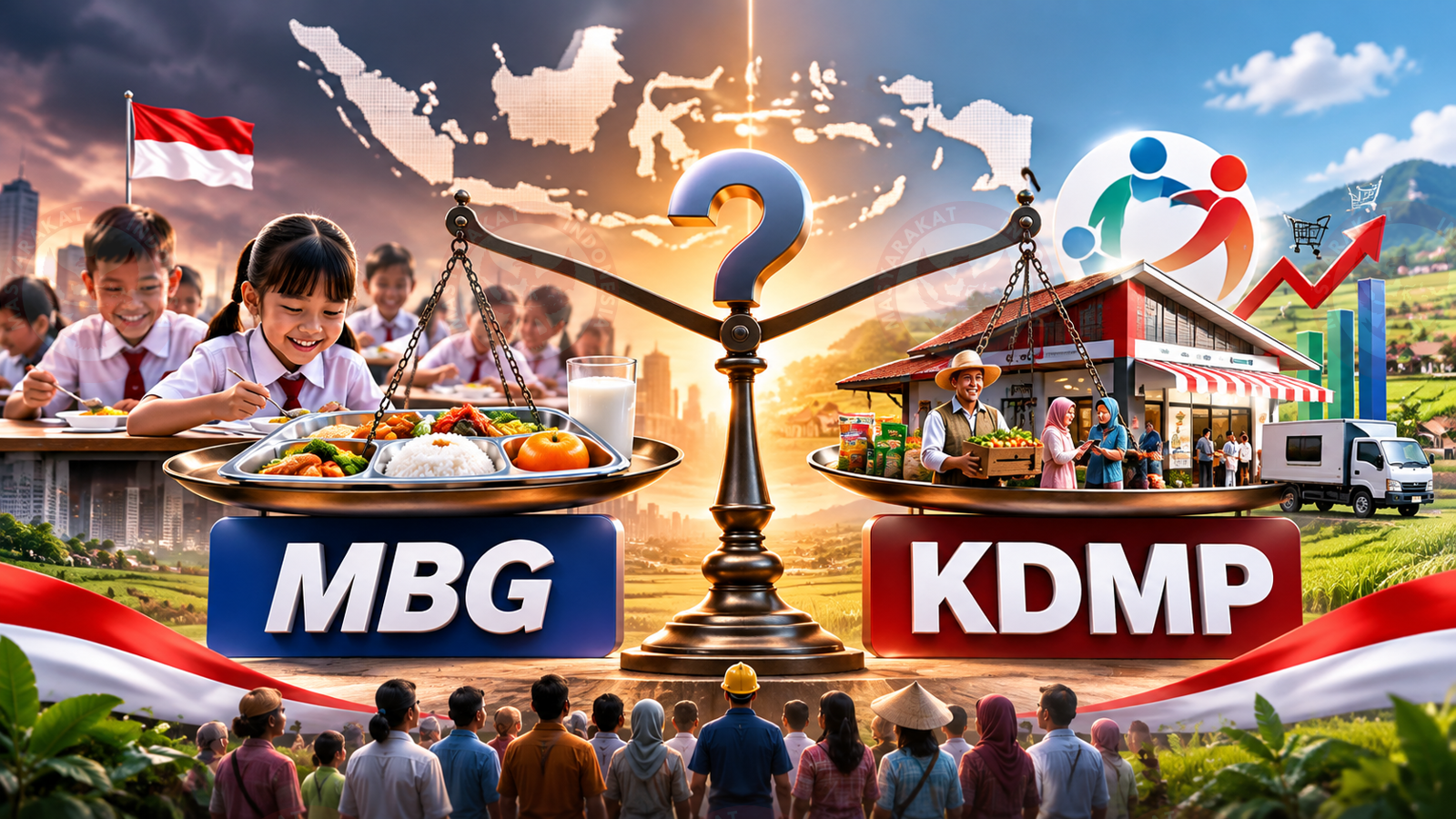
Jakarta, August 12, 2026 — The Makan Bergizi Gratis (MBG) and Koperasi Desa/Kelurahan Merah Putih (Kopdes Merah Putih) programs are two major initiatives that form part of the development agenda of President Prabowo Subianto's government.
Both have goals that are fundamentally positive. MBG is expected to help improve how well people's nutritional needs are met while also driving the food economy chain. Kopdes Merah Putih, meanwhile, is designed to strengthen village economies through cooperatives and community economic activity.
However, the sheer scale of these two programs raises a question that we believe is important to discuss openly:
Are these two programs the most urgent priority right now, or are there basic needs of the people that should be strengthened first?
As part of the Indonesian diaspora living abroad, we take the view that development priorities need to start from the most basic foundations: jobs, health, and education.
MBG: a nutrition investment or a program that is too big?
Children need nutritious food to grow and develop. Improving nutrition from an early age can also be a long-term investment in the quality of Indonesia's human resources. But the bigger the program, the bigger the challenge of managing it.
Food safety, food quality, distribution, oversight, budget efficiency, and the quality of ingredients are all things that must be taken seriously.
That is because the success of MBG should not be measured only by how many meals it manages to distribute, but also by these questions:
Is the food safe? Is its nutritional content appropriate? Does it reach the right people? And does the budget spent produce the maximum benefit?
What about Kopdes Merah Putih?
The second program, no less large, is Koperasi Desa/Kelurahan Merah Putih. The government is targeting the creation of tens of thousands of cooperatives to strengthen village economies.
If managed properly, cooperatives can help village communities gain access to markets, financing, distribution, and procurement of goods. Farmers, for example, can use a cooperative as a place to pool their produce before selling it in larger volumes.
But setting up a cooperative does not automatically create prosperity. A cooperative needs a real business.
- There has to be a product.
- There have to be customers.
- There has to be management.
- There has to be a profit.
And most importantly, there have to be members who genuinely own and use the cooperative.
PMK Nomor 7 Tahun 2026 allocates about 58.03 percent, or Rp34.57 trillion, of the 2026 Dana Desa to support the implementation of KDMP, while the total 2026 Dana Desa is set at Rp60.57 trillion.
That figure shows how serious the government is about pushing this program. But the greater the support from the state, the greater the demand for transparency and results.
So what do we think is more urgent?
This is where our perspective as diaspora may differ somewhat. We do not see MBG and Kopdes as bad programs.
But we do question the order of priorities.
In our view, there are three foundations that are extremely important to strengthen first, seriously and evenly across all of Indonesia.
1. Jobs and a decent income
In our view, the most basic issue is the availability of jobs that are sufficient in number, productive, and easy for Indonesians to access.
Imagine a family whose head of household has a steady job and a decent income.
With that income, the family can buy nutritious food, pay for the children's education, access health services, have decent housing, and save for the future.
Food assistance programs can help people meet their needs in the short term.
But decent work gives a family the ability to meet its own needs independently over the long term.
2. A health system that reaches everyone
The second foundation is health.
We still hear many stories about people in remote areas who have to travel long distances to get health care.
In some regions, health facilities are still limited, health workers are unevenly distributed, and the quality of service is not yet the same between urban and remote areas.
Another issue is the welfare of health workers.
We also see complaints about delayed payment of salaries or entitlements for health workers in a number of regions.
In our view, issues like this need serious attention.
Because health is a basic need that cannot wait.
People should be able to obtain decent health care when they need it, regardless of whether they live in a city center, a village, a small island, or a remote interior region.
Building health facilities, expanding access, providing enough medical staff, ensuring the availability of medicines and equipment, and guaranteeing the welfare of health workers are all very important investments in Indonesia's future.
3. Education that is easy to access and teachers who are well provided for
The third foundation is education.
There are still Indonesian children who struggle to get an education because of the distance to school, geographical conditions, limited facilities, or their family's economic situation.
In our view, the government needs to keep making sure that every Indonesian child has access to a decent, quality school.
If a village has a fairly large number of school-age children but the school is too far away, then access to education is not yet truly equal. For that reason, building schools and distributing them evenly needs to be a focus.
But building school buildings alone is not enough. Teachers must also enjoy a decent standard of living. Teachers are one of the main foundations of education. They need a decent income, job security, adequate facilities, and respect for their profession.
If quality education can be accessed by every child, then Indonesia is building the human resources that will determine the country's future for decades to come.
Closing: our opinion as diaspora
This piece is our opinion as Indonesian diaspora living abroad.
We do not claim to have all the answers, and we do not intend to pass judgment on government policy. We only hope that Indonesia's development always places the needs of its people as the top priority. In our view, jobs, health, and education are three truly fundamental foundations.
If all three grow stronger and more evenly spread, then programs like MBG and Kopdes Merah Putih can reinforce development and deliver far greater benefits.
In the end, we do not want to see Indonesia known only for the size of its government programs. We want Indonesia to be known for people who are prosperous, healthy, educated, productive, and able to live independently.
This is our hope as Indonesian diaspora for our homeland.



Comments (0) View in forum
Discuss this article in the community Ask questions, share your thoughts, and chat with other members.21 people have already joined this community. Join in to comment and like posts!
No messages yet — be the first.